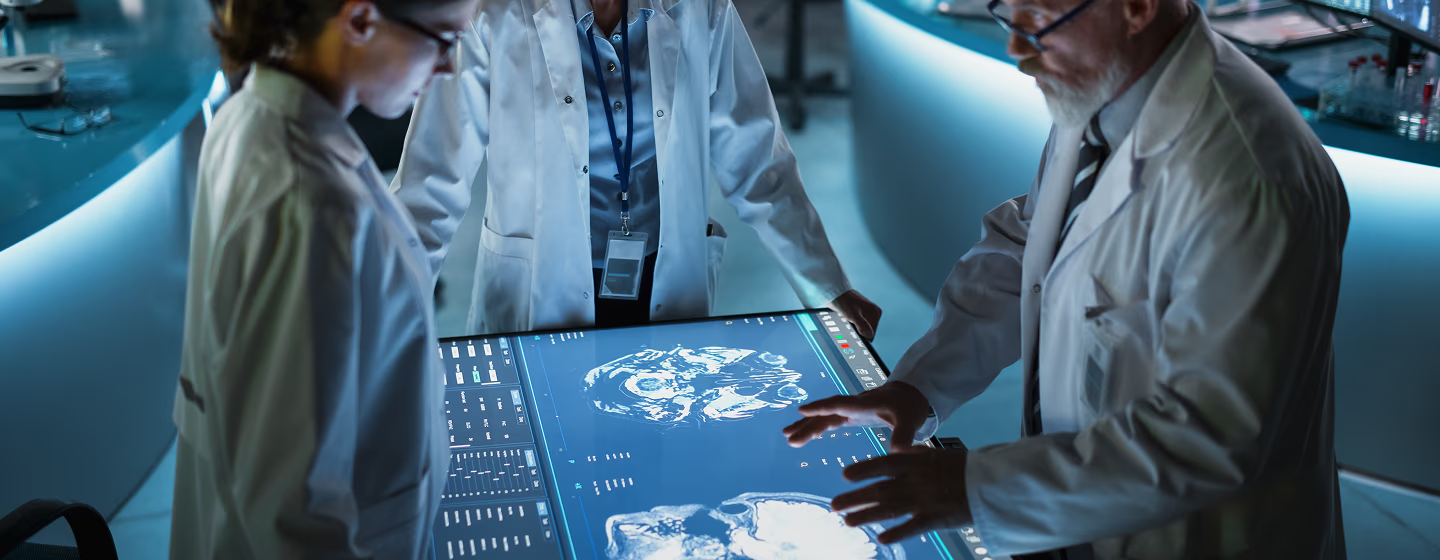
Advancing Treatment for Addiction and Pain Through the Science of MORE
Modern life is beset by struggle. To alleviate the resultant physical and emotional pain, we often turn to unhealthy coping habits: We eat too much, we use drugs and alcohol, and we numb ourselves with binge watching, doomscrolling, and social media. These strategies work in the short term, but in the long term, they make us feel worse by dysregulating the stress and reward circuitry of the brain. Consequently, epidemiologists have noted a rise in mortality due to addiction, emotional distress, and chronic pain. These "diseases of despair" ensnare us in a downward spiral. But is there a way out of the trap?
The Antidote to Diseases of Despair
I am an endowed professor, a psychotherapist, and a biobehavioral scientist with over 20 years of experience helping people heal from diseases of despair and reclaim a meaningful life from addiction, stress, and pain. The goal of my work is to translate findings from affective neuroscience into the development of treatments that effectively target transdiagnostic mechanisms underpinning addiction, emotion dysregulation, and chronic pain.
I’ve spent the last two decades developing Mindfulness-Oriented Recovery Enhancement (MORE), a breakthrough, evidence-based, mind-body therapy that integrates training in mindfulness, reappraisal, and savoring skills to help people to heal from physical and emotional pain and free themselves from addictive behavior. MORE has been tested in over 16 randomized clinical trials involving more than 2000 patients, and has been shown to be nearly three times as effective as standard therapy for treating addiction and chronic pain, while at the same time significantly reducing symptoms of depression and post-traumatic stress. MORE is unique among other psychotherapies in that it also increases natural healthy pleasure, joy, meaning, and self-transcendence — the sense of being connected to something greater than the self. Neuroscience has shown MORE helps to heal the brain’s reward system, and in so doing MORE provides a potent antidote to diseases of despair.
Healing Is Possible
I'd like to end on a hopeful note: Leading-edge science supports the notion that recovery is possible. Over the past several decades there has been an explosion of research demonstrating that our thoughts, feelings, and actions can change the function (and perhaps even the structure) of our brains. Research has even begun to demonstrate that our brains can be modified by mental training, not unlike the way people lift weights to build the size and strength of their muscles.
By practicing techniques like mindfulness, reappraisal, and savoring on a regular basis, you can help yourself heal and reclaim a meaningful life from addiction, stress, and chronic pain.
Insights from Dr. Garland
Reclaiming Inner Resources
We all have the innate capacity to radically shift our attention
Learn MORE
Quieting the Addicted Brain
How MORE changes brain activity to reduce opioid misuse and cravings.
Learn MORE
One Therapy for All
One therapy for addiction, pain, and trauma—targeting shared processes.
Learn MORE
Healing from Addiction
Mental training to restore joy and reduce cravings through brain rewiring.
Learn MORE
Know MORE
Sign up to receive Dr. Garland's insights